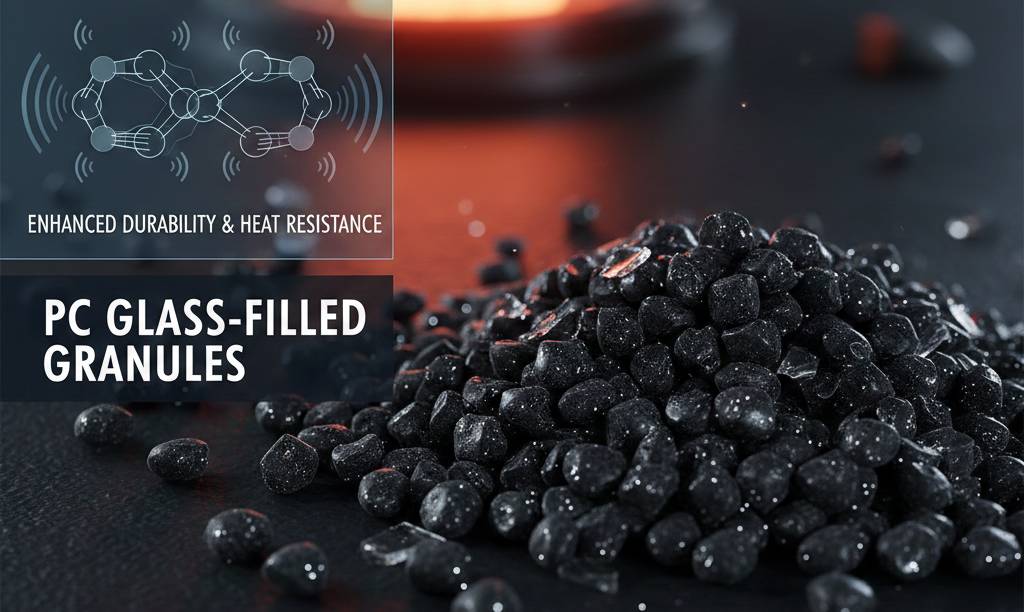
Today, industries require materials that can withstand extreme heat, mechanical stress, and prolonged use without degrading. PC glass-filled granules have emerged as a high-performance solution for automotive, electrical, electronics, and engineering applications where strength, dimensional stability, and thermal resistance are crucial.
By reinforcing polycarbonate with finely ground glass fibers, manufacturers achieve excellent rigidity, reduced warping, and improved heat tolerance, while also maintaining good processability.
AI-driven materials research, predictive manufacturing, and smart industrial automation are accelerating innovation, and glass-filled polycarbonate is now at the heart of next-generation engineering plastics, powering safer vehicles, smarter electronics, and more reliable industrial systems.
Why PC Glass-Filled Granules Matter in Modern Industry
Traditional plastics often fail to perform under high temperatures, heavy loads, or continuous mechanical stress. In contrast, PC glass-filled granules for industrial use are designed to function even where standard polymers fail.
Adding glass fibers transforms basic polycarbonate into a strong composite material with the following characteristics:
- Higher tensile strength
- Improved heat resistance
- Lower thermal expansion
- Better dimensional stability
- Reduced creep under load
These properties make glass-filled PCs highly valuable in industries where reliability and safety cannot be compromised.
The Science Behind Glass Reinforcement in Polycarbonate
Polycarbonate is already a strong, transparent, and impact-resistant thermoplastic. However, when combined with short glass fibers, its mechanical and thermal properties are significantly improved.
Glass fibers act like microscopic reinforcing rods within the polymer matrix. This creates a hybrid material that is as strong as metal but retains the lightweight advantages of plastic.
The main technical advantages include:
- Heat Deflection Temperature (HDT) increases significantly
- Better resistance to deformation at high temperatures
- Reduced shrinkage during injection molding
- Enhanced load-bearing capability
Manufacturers frequently use PC glass-filled granules for parts that must remain stable under heat and pressure.
Automotive Applications: Built for Extreme Conditions
The automotive industry is one of the largest users of glass-filled polycarbonate. Modern vehicles operate under very demanding conditions, including engine heat, vibration, and mechanical stress.
Common applications include:
- Under-the-hood components
- Electrical housings
- Sensor casings
- Headlamp brackets
- Battery enclosures (EV applications)
- Structural interior panels
Because glass-filled PCs can withstand high temperatures without deforming, it is ideal for parts located near engines or exhaust systems.
With the rise of electric vehicles (EVs), the demand for heat-resistant, lightweight materials has increased, making PC glass-filled granules even more valuable.
Electronics and Electrical Industry: Safety Meets Performance
In electronics, heat management and structural stability are crucial. Circuit boards, connectors, and housings must withstand thermal stress while protecting sensitive components.
Glass-filled polycarbonate is widely used in the following applications:
- Switchgear housings
- Electrical connectors
- Relay casings
- Power distribution units
- Consumer electronics frames
Its fire-retardant properties and electrical insulation capabilities add an extra layer of safety, reducing the risk of fire in high-voltage environments.
AI-powered manufacturing lines now use predictive analytics to optimize the injection molding of glass-filled PCs, ensuring consistent quality and reducing defects.
Industrial Machinery and Heavy Equipment
Heavy machinery components are subjected to constant stress, vibration, and friction. Traditionally, these parts were made of metal, but they are heavy and prone to corrosion.
Glass-filled polycarbonate offers a lightweight, corrosion-resistant alternative for these applications:
- Gear housings
- Mechanical covers
- Structural brackets
- Conveyor system components
- Industrial enclosures
By using reinforced PCs instead of metal, manufacturers reduce weight, increase energy efficiency, and lower production costs.
Heat Resistance: A Game-Changer for Engineering Plastics
The biggest advantage of PC glass-filled granules is their excellent heat resistance. Compared to standard polycarbonate, glass-filled grades can withstand much higher temperatures without losing their shape or strength.
Common reforms include:
| Property | Standard PC | Glass-Filled PC |
| Heat Deflection Temp | ~135°C | 150–160°C+ |
| Tensile Strength | Moderate | High |
| Dimensional Stability | Good | Excellent |
| Warpage | Possible | Minimal |
This makes a glass-filled PC suitable for high-temperature industrial and automotive environments.
Dimensional Stability and Precision Manufacturing
In precision engineering, even small dimensional variations can lead to part failure. Glass-filled PCs significantly reduce shrinkage and warping during molding.
This is especially important for them:
- Tight-tolerance components
- Precision connectors
- Structural frames
- Medical device housings
Now, AI-based simulation tools help engineers predict how glass-filled polycarbonate will behave during molding, reducing trial and error and speeding up production.
Sustainability and Recycling Potential
While glass-filled polycarbonate is a composite material, recycling techniques are rapidly improving. Manufacturers are finding ways to recover and reuse reinforced plastics without compromising performance.
The benefits include:
- Reduced landfill waste
- Lower carbon footprint
- Circular economy potential
- Cost-efficient material recovery
Distributors like Authorized Distributor of PC Granules – Kapoor Sales support responsible sourcing and supply of high-quality engineering plastics aligned with sustainability goals.
AI, Smart Manufacturing, and Material Optimization
Artificial intelligence is changing how materials like glass-filled polycarbonate are designed, tested, and manufactured.
AI applications include:
- Predicting mechanical performance
- Optimizing fiber distribution in resin
- Reducing manufacturing defects
- Enhancing molding efficiency
- Automating quality inspection
Smart factories use machine vision and machine learning to detect defects in molded parts, ensuring that only top-quality products reach the market.
Why Manufacturers Choose Glass-Filled PC Over Alternatives
Compared to other reinforced plastics, glass-filled polycarbonate offers a unique balance of strength, heat resistance, and ease of processing.
| Material | Strength | Heat Resistance | Weight | Processability |
| Glass-Filled PC | Very High | Very High | Light | Excellent |
| Glass-Filled Nylon | High | Moderate | Light | Good |
| Metal (Aluminum) | Very High | High | Heavy | Complex |
| ABS Plastic | Low | Low | Light | Easy |
This combination makes a glass-filled PC a preferred choice for high-performance applications.
Compliance and Industrial Standards
The quality glass-filled polycarbonate must meet international standards, such as:
- UL flame ratings
- ISO mechanical performance benchmarks
- RoHS compliance
- Automotive-grade certifications
Suppliers like Kapoor Sales ensure that all distributed materials meet strict global quality requirements.
Future of PC Glass-Filled Granules
The future of glass-filled polycarbonate looks very promising, with its growing applications in the following areas:
- Electric vehicles
- Renewable energy systems
- Smart grids
- Robotics
- Aerospace components
- 5G infrastructure
As industries require stronger, lighter, and more heat-resistant materials, the use of glass-filled PCs will continue to increase.
Conclusion
PC glass-filled granules are revolutionizing modern engineering by combining the strength of polycarbonate with glass fibers. From automotive systems to electronics and heavy machinery, this material offers unparalleled durability, heat resistance, and dimensional stability.
 Moz SEO
Leave a comment