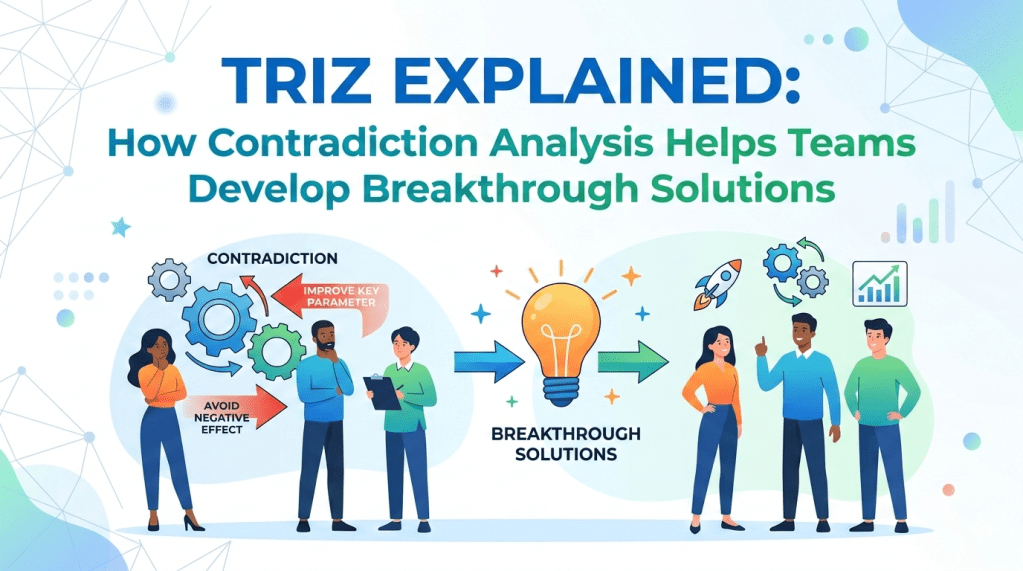
Innovation is often misunderstood as a creative spark, a sudden moment of inspiration that leads to breakthrough results. In reality, structured innovation methods consistently outperform random brainstorming. One of the most powerful and time-tested methodologies for systematic innovation is TRIZ.
TRIZ, a Russian acronym for “Theory of Inventive Problem Solving,” provides a structured framework for solving complex problems by analyzing contradictions. Rather than accepting trade-offs, TRIZ challenges teams to eliminate them.
A detailed explanation of this method can be found here:
TRIZ Explained: How Contradiction Analysis Helps Teams Develop Breakthrough Solutions
This resource explores how contradiction analysis drives practical innovation across industries.
What Is TRIZ?
TRIZ was developed by Genrich Altshuller after studying thousands of patents to identify patterns in innovative solutions. He discovered that breakthrough inventions rarely emerge from randomness; they follow predictable principles.
At its core, TRIZ focuses on solving contradictions.
A contradiction occurs when improving one aspect of a system worsens another.
For example:
- Increasing product strength increases weight.
- Improving speed reduces stability.
- Enhancing safety increases cost.
Traditional thinking accepts trade-offs. TRIZ rejects them.
Understanding Contradiction Analysis
Contradiction analysis is the heart of TRIZ. Instead of compromising between two competing factors, teams ask:
“How can we improve one parameter without worsening the other?”
There are two primary types of contradictions:
1. Technical Contradictions
When improving one system parameter negatively affects another.
2. Physical Contradictions
When a single parameter needs to exist in two opposite states simultaneously.
TRIZ provides structured tools to resolve both types without compromise.
Another version of this discussion is available here:
This article reinforces how TRIZ applies across engineering and industrial problem-solving contexts.
Why Traditional Brainstorming Falls Short
Many organizations rely heavily on brainstorming sessions. While useful, brainstorming often:
- Produces incremental ideas
- Lacks structured direction
- Encourages compromise solutions
- Fails to address root contradictions
TRIZ, on the other hand, is systematic. It uses proven innovation principles derived from real-world inventions.
Instead of asking, “What ideas do we have?” TRIZ asks, “What contradiction must we eliminate?”
This subtle shift changes the quality of solutions dramatically.
The 40 Inventive Principles
One of the most famous TRIZ tools is the list of 40 Inventive Principles. These principles provide solution patterns that have repeatedly resolved contradictions across industries.
Examples include:
- Segmentation
- Prior Action
- Dynamicity
- Nested Systems
- Parameter Changes
- Feedback
When teams identify a contradiction, they consult the TRIZ contradiction matrix to find which principles are most likely to solve it.
This structured approach reduces guesswork and accelerates innovation cycles.
A broader discussion of TRIZ application is also published here:
Real-World Applications of TRIZ
TRIZ is not limited to engineering. It has been successfully applied in:
- Manufacturing
- Healthcare
- Oil & Gas
- Chemical Processing
- IT and Software Development
- Product Design
- Supply Chain Optimization
For example:
In manufacturing, a company may want to increase machine speed without increasing defect rates. TRIZ helps identify system modifications that remove this trade-off.
In product design, engineers may want lightweight materials that remain durable. Instead of choosing between strength and weight, TRIZ encourages alternative material configurations or structural innovations.
Another detailed version of the topic can be found here:
How Contradiction Analysis Drives Breakthrough Thinking
Contradictions force teams to think beyond incremental improvement.
When teams accept trade-offs, innovation stalls.
When teams challenge contradictions, they explore entirely new solution spaces.
For example:
Instead of accepting that “higher throughput reduces quality,” a TRIZ-driven team may redesign process flow or introduce adaptive control systems.
Instead of accepting that “more automation increases cost,” teams may identify modular automation strategies that reduce long-term expense.
Contradiction analysis creates structured creativity.
TRIZ and Continuous Improvement
TRIZ complements methodologies like Lean and Six Sigma.
While Lean eliminates waste and Six Sigma reduces variation, TRIZ removes design limitations.
Lean might ask:
“How can we streamline this process?”
TRIZ asks:
“Why does this process limitation exist in the first place?”
Together, these approaches build both operational excellence and innovation capability.
A structured explanation of TRIZ principles is also documented here:
Why Organizations Struggle With Innovation
Many organizations claim innovation as a strategic priority, yet struggle to produce breakthrough results.
Common barriers include:
- Fear of risk
- Short-term performance pressure
- Lack of structured problem-solving methods
- Overreliance on experience-based thinking
TRIZ reduces uncertainty by providing a logical path toward inventive solutions.
Instead of waiting for inspiration, teams follow structured steps:
- Define the problem precisely.
- Identify the contradiction.
- Map the contradiction using TRIZ tools.
- Apply relevant inventive principles.
- Prototype and validate.
This disciplined approach accelerates innovation while reducing trial-and-error costs.
Benefits of TRIZ Implementation
Organizations that adopt TRIZ report:
- Faster product development cycles
- Reduced design compromises
- Improved cross-functional collaboration
- Higher-quality breakthrough ideas
- Stronger competitive advantage
Most importantly, TRIZ builds internal capability. Teams become skilled at identifying hidden contradictions and resolving them systematically.
TRIZ in the Era of Digital Transformation
As industries integrate artificial intelligence, automation, and advanced analytics, contradictions become more complex.
For example:
- Automation increases efficiency but reduces flexibility.
- Data transparency improves control but increases cybersecurity risk.
TRIZ helps navigate these modern challenges by structuring complex problem-solving in dynamic systems.
Innovation in the digital age requires more than creativity, it requires methodology.
Building a TRIZ Culture
Successful TRIZ adoption requires:
- Leadership commitment
- Structured training programs
- Real-world project application
- Cross-functional workshops
- Ongoing reinforcement
TRIZ works best when embedded into the organizational problem-solving culture rather than used as a one-time workshop tool.
Conclusion
TRIZ is more than an innovation framework; it is a disciplined approach to eliminating trade-offs.
Contradiction analysis challenges the assumption that improvement must come with compromise. By identifying and resolving core conflicts within systems, teams unlock breakthrough solutions that traditional thinking overlooks.
Organizations seeking sustained competitive advantage cannot rely solely on incremental improvement. They must build systematic innovation capability.
TRIZ offers that structure.
In a world where complexity continues to increase, the ability to resolve contradictions rather than accept them will define tomorrow’s industry leaders.
 Moz SEO
Leave a comment